I am a graduate student at LSU investigating the geomicrobiology of Taylor Glacier. I have been on two expeditions to Antarctica as part of a field research team. This blog is part of my science outreach project to K-12 students in Louisiana. I hope that it will allow students witness scientific research in action, and perhaps encourage those interested to pursue scientific careers in the future.
Gave a talk to the 4th grade students about science expeditions to Antarctica and showed them some of the Taylor samples up close. The students loved it. I have to give a big thanks to Mrs. Bonsall and Mrs. Alicia Guidry for their help.
This January, the JSHS was at LSU. I had the privilege to setup a station after the symposium so that the students could witness first hand some of the research actually taking place at LSU. There was great turnout of students who asked some great questions and really enjoyed "touching" Antarctica.
The initial batch of samples have arrived back at LSU. The majority of our ice samples come back on a ship, and won't be here until April, but a lucky few of our sample filters got to come home early for Christmas by airplane. Unfortunately, it is very expensive to ship samples home by air, and the majority of our samples must come home on the boat. Nevertheless, I am confident that the these initial filtered samples will provide some great results during the mean time.
I am in Montreal for 10 days during the Christmas holidays, so I'm back in the snow again after escaping Antarctica. HaHa. Luckily though, I won't be sleeping in a tent this time.
Filtering has finally been completed. In total we filtered ~91 liters of sample! Our next primary objective was to extract RNA from one of the filters and quickly convert it to cDNA to prevent degradation. We can then ship the cDNA back to LSU to sequence.
While challenging, the information we will learn from this type of analysis will be very valuable. Sequencing the 16s rRNA fragment directly allows us to determine which species of microbes have remained viable when trapped inside Taylor Glacier. The normal method of just sequencing the 16s rRNA gene (which is located on DNA, not RNA) only tells us which microbes were present in the glacier at one point in time. Any microbes which died in the glacier thousands of years ago would no longer be viable, but may have have left there DNA behind. In other words, with DNA alone, it is difficult to tell which sequences came from viable cells as opposed to those sequences which came from dead cells.
Our extraction turned out to be a success as we managed to extract ~25ng of RNA from one filter!!! From this RNA we reverse-transcribed the 16s rRNA molecules to cDNA which is now on it's way to LSU to be sequenced!
Additionally, we measured the amount of ATP in our samples with the luminometer (as described last month on the blog). This experiment was successful as well, indicating about 10,000 cells/mL. This reinforces some direct microscopic cell counts we did earlier which yield roughly the same amount.
After some initial difficulties with filters clogging Amanda and I have finally gotten into a good rhythm of cleaning ice, melting ice, pre-filtering melt water, centrifuging sediment, and filtering. We are managing to put about 10 liters of melt through each filter!
Hey Guys! I'm back in McMurdo and back in the lab ready to go. Its nice to be back and enjoy the comforts of being inside, out of the wind. Here's an overview of what I am doing in the lab:
I want to concentrate about 150kg of our sample ice down onto filters for further experimentation. Several tests such as DNA or RNA analysis rely on relatively large amounts of cells to work efficiently. Our ice samples only have a few thousand microbial cells per mililiter. This may sound like a lot, but it's actually quite low. For example, one gram of soil commonly contains several million cells per mililiter. By filtering several gallons of melted sample onto a filter, I can thus concentrate the microbes to levels which will result in a reliable signal.
First, I will need to decontaminate the outer surfaces of our samples. The ice has been handled extensively during collection and it's imperitive we remove any foreign chemicals or microorganisms we inadvertantly added.
Here is what happens when you don't decontaminate samples. These are microscope images of filtered ice. The samples have been stained with a dye which glows bright green when it binds to DNA. As you can see on the left, the sample that was not decontaminated has lots of foreign material. The sample on the right was cleaned prior to filtering.
To decontaimnant the ice, we melt the outer surfaces away from the ice using sterilized water. This is the apparatus I setup to sterilize the water. Normally, we would just autoclave large carboys of water but unfortunately, McMurdo does not have any autoclaves large enough to do so on station. As a result, I must sterilize the water by filtration as shown above. On the far left is the carboy of water to be sterilized, followed to the right by a large parastolic pump. The wooden box in the middle is a portable laminar flow hood which is simply a fan which pushes air through a HEPA filter. This is to help prevent contamination from any microbes normally floating around in the lab. Finally, on the far right, is my collection bottle in which the filtered water is collected.
A variety of glassware which has been washed and autoclaved. As you can see, one cannot take contaimination lightly in a microbiology lab.
This is the ice cleaning station we created. We set samples on the grill right next to the laminar flow hood and pour the clean water all over the sample to melt away the outer contaimination.
Amanda uses forceps to manipulate and position the ice sample on the cleaning station.
A close-up of one of our samples. It looks pretty awesome once you clean them off.
This is the leftover sediment which was washed off the outside of our samples.A dear, dear, friend of mine which I haven't seen since I left Louisiana. I was very happy to find a six-pack in the station store.
We have completed sampling and I will be heading back to McMurdo tomorrow to begin analysis. My main goals will be to concentrate a large volume of sample onto filters. More details and pictures to come once I return to McMurdo.
After completion of the tunnel and sampling room, we must construct a small "freezer" to store our samples inside the tunnel until they can be flown out by helicopter. Otherwise, any samples stored outside the tunnel would be subject to direct 24-hour sunshine.
To construct this "freezer", Tim and I use the same technique we used to build the tunnel last week: Cut a tic-tac-toe pattern into a wall, and then smash the ice out with a demolition hammer. Because of the increased space of the sampling room (4x3 meters), were able to hook up two chainsaws to speed up the process (we also both possess Totin' Chips)!
Sorry for the late update. The repeater which allowed us to have internet at our field site was offline for a few days after a storm.
Lindsay Knippenberg hikes back up the glacial apron pulling the "ice removal" sled behind her. Notice the large pile of ice we have created in the construction of the tunnel. Last season we removed over 55 metric tons of ice during the tunnel excavation. We might be close to beating that record this season.
Lindsay and Tim inspect the "sampling room's" rear wall as it nears completion. The large dark band in the middle is a layer of sediment entrapped in the glacier. Currently, it is not fully understood how these layers form. A look from the inside of the tunnel out. Myself inside the tunnel. Pretty cool photo of an A-Star which just dropped off some more supplies at camp via sling load (cargo net carried underneath the chopper).
P.S. Anyone is able to post comments or questions in the comments section below each post. It is not reserved for only the SHS students.
We have completed our first three days of tunneling and have already reached 6.0 meters! A few more meters inwards and we will being to dig downwards and prep for sampling. The idea is that once we tunnel far enough inside the glacier we will reach an area where the glacial ice is not highly deformed from margin effects. The margins, the edges of a glacier, are often deformed due to events such as calving (breaking off of a large mass of ice from the glacier) or melting.
Once we feel we are sufficiently inside the glacier, we will dig a pit down to sample the sediment-laden striated ice underneath. It is in these sediment layers we have detected high levels of CO2 paired with low levels of O2, indicating a possibility of microbial aerobic respiration! Additionally, we have found increased areas of methane, another possible signal of microbial activity in ice.
This is a view of the Ferrar glacier on the way to Taylor Glacier.
We land at camp and unload all our gear from the Bell 212 Helicopter. Our camp is now officially in the field and goes by the call sign "Bravo Two Three Six - Blood Falls" over radios comms.
Working as a group to set up a Scott tent at camp. This tent serves as our bathroom.
A few of our personal tents in which we sleep.
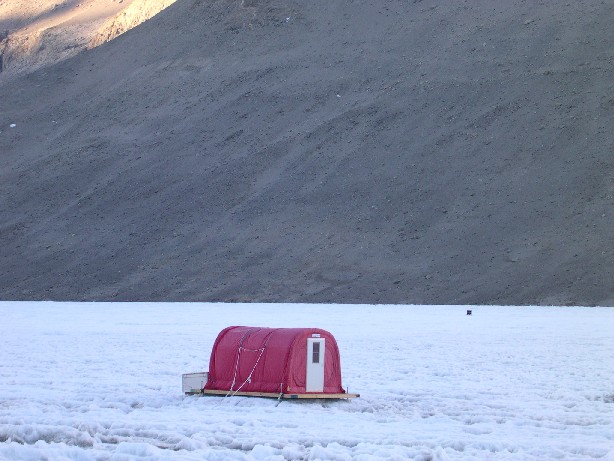
Here's a few from Lake Bonney towards our main camp. The red polar haven is our kitchen/food tent where we cook and eat our meals. The blue polar haven serves as a heated storage tent for storing items which can't freeze (i.e. canned goods, cokes, etc...).
A close up of the main polar haven.
We all have our laptops out checking our emails. Most of us had dozens of unread messages to check due to the internet downtime this past week. Melting glacial ice from Taylor for drinking water.
Amanda Achberger cutting stairs into the glacial apron leading up to our tunnel with the gas-powered chainsaw. Amanda and Brent work on the very beginning of our tunnel into Taylor Glacier. At this point we have moved to using electric chainsaws. The gas powered chainsaws release too much exhaust to use safely in the tunnel.
Our helicopter flight out to the field camp was delayed until after the weekend. Before we are allowed to deploy, McMurdo sends out carpenters to build the Polar Havens. These are large, durable tents which we use for our kitchen and storage. Because of weather delays earlier in the week, they weren't able to build them in time for us to deploy on the weekend.
This isn't our polar haven, but it is very similar to what ours will look like.


 Here is what happens when you don't decontaminate samples. These are microscope images of filtered ice. The samples have been stained with a dye which glows bright green when it binds to DNA. As you can see on the left, the sample that was not decontaminated has lots of foreign material. The sample on the right was cleaned prior to filtering.
 To decontaimnant the ice, we melt the outer surfaces away from the ice using sterilized water. This is the apparatus I setup to sterilize the water. Normally, we would just autoclave large carboys of water but unfortunately, McMurdo does not have any autoclaves large enough to do so on station. As a result, I must sterilize the water by filtration as shown above. On the far left is the carboy of water to be sterilized, followed to the right by a large parastolic pump. The wooden box in the middle is a portable laminar flow hood which is simply a fan which pushes air through a HEPA filter. This is to help prevent contamination from any microbes normally floating around in the lab. Finally, on the far right, is my collection bottle in which the filtered water is collected.
 A variety of glassware which has been washed and autoclaved. As you can see, one cannot take contaimination lightly in a microbiology lab.
 This is the ice cleaning station we created. We set samples on the grill right next to the laminar flow hood and pour the clean water all over the sample to melt away the outer contaimination.
 Amanda uses forceps to manipulate and position the ice sample on the cleaning station.
 A close-up of one of our samples. It looks pretty awesome once you clean them off.
 This is the leftover sediment which was washed off the outside of our samples.
 A dear, dear, friend of mine which I haven't seen since I left Louisiana. I was very happy to find a six-pack in the station store.


 Lindsay and Tim inspect the "sampling room's" rear wall as it nears completion. The large dark band in the middle is a layer of sediment entrapped in the glacier. Currently, it is not fully understood how these layers form.
 A look from the inside of the tunnel out.
 Myself inside the tunnel.
 Pretty cool photo of an A-Star which just dropped off some more supplies at camp via sling load (cargo net carried underneath the chopper).

 This is a view of the Ferrar glacier on the way to Taylor Glacier.
 We land at camp and unload all our gear from the Bell 212 Helicopter. Our camp is now officially in the field and goes by the call sign "Bravo Two Three Six - Blood Falls" over radios comms.
 Working as a group to set up a Scott tent at camp. This tent serves as our bathroom.
 A few of our personal tents in which we sleep.
 Here's a few from Lake Bonney towards our main camp. The red polar haven is our kitchen/food tent where we cook and eat our meals. The blue polar haven serves as a heated storage tent for storing items which can't freeze (i.e. canned goods, cokes, etc...).
 A close up of the main polar haven.
 We all have our laptops out checking our emails. Most of us had dozens of unread messages to check due to the internet downtime this past week.
 Melting glacial ice from Taylor for drinking water.
 Amanda Achberger cutting stairs into the glacial apron leading up to our tunnel with the gas-powered chainsaw.
 Amanda and Brent work on the very beginning of our tunnel into Taylor Glacier. At this point we have moved to using electric chainsaws. The gas powered chainsaws release too much exhaust to use safely in the tunnel.